Shopify handles the sale. Orderkraft handles what happens after.
For Shopify brands that make, assemble, or configure products after the order. Orderkraft adds the production layer Shopify was never built for: manufacturing orders, materials, lead times, and fulfillment.

Shopify stops at inventory.
It knows what's in stock. It doesn't know what still needs to be produced.
What Orderkraft sees
- Shopify Inventory count
- Orderkraft Materials needed to build this order
- Shopify Order paid
- Orderkraft Production stage and queue position
- Shopify Fulfillment pending
- Orderkraft What can ship now, what's still being made
- Shopify Estimated delivery
- Orderkraft Real lead time for this exact configuration
So ops becomes the translation layer. Spreadsheets, Slack threads, late-night fixes, partial fulfillments, oversold materials, support tickets. Production keeps moving, held together by the person who happens to know how the system works.
Built for brands that…
- You produce, assemble, or configure products after the order comes in.
- Your catalog mixes stocked items with made-to-order items.
- You manage components or materials, not just finished goods.
- Lead times depend on what's in the queue, not a number in a spreadsheet.
- Your ops team coordinates production in Slack, sheets, and someone's head.
- Marketing and production don't share the same source of truth.
If two or three of these sound like your Tuesday, you're who we built this for.
Three places production quietly falls apart.
The system works until the person who built it leaves.
Someone wrote the Zapier automation. Someone built the sheet. Someone knows which column means what. That person is ops. When they take parental leave, get sick, or find a better job, production finds out the hard way. Orderkraft puts the logic in the system, not in a person.
Marketing promised two weeks. Ops found out when the customer complained.
Delivery dates are guesses when nothing connects the storefront to the floor. What's the current queue? How long does this product actually take? Nobody knows until it's too late to fix. Orderkraft connects what gets sold to what can actually be built, so promises are real before they're made.
Ops shouldn't have to ask what to build next.
The answer is in a sheet. Or a Slack message. Or someone's head. Or all three, and they disagree. A clear, prioritized queue shouldn't be a luxury. It should be the most normal thing in the world. It isn't, yet. Orderkraft makes it that.
Here's what happens after an order comes in.
Seven steps, mostly invisible. Shopify keeps doing what Shopify does. Orderkraft handles the production side from the moment the order lands.
-
Order placed in Shopify
A customer checks out. Shopify captures the sale and the configuration. Stocked line items behave the way they always have.
-
Production requirements generated
Orderkraft reads the made-to-order line items, resolves their bill of materials, and works out what actually needs to be built.
-
Components and materials allocated
Required components are reserved against on-hand stock. Shortfalls surface immediately, not at the warehouse.
-
Manufacturing order created
A production-side record of the work: what's being built, for which order, with which materials, by when.
-
Stocked items released for fulfillment
If the order mixes stocked and made-to-order items, the stocked items can ship now. The rest waits for production.
-
Production tracked through to ready
Ops moves the manufacturing order through its stages. Lead-time estimates on the storefront stay in sync with the floor.
-
Fulfillment released automatically
When production is complete, Orderkraft releases the remaining items for fulfillment. No one chases a spreadsheet to know it happened.
Production, directly inside Shopify.
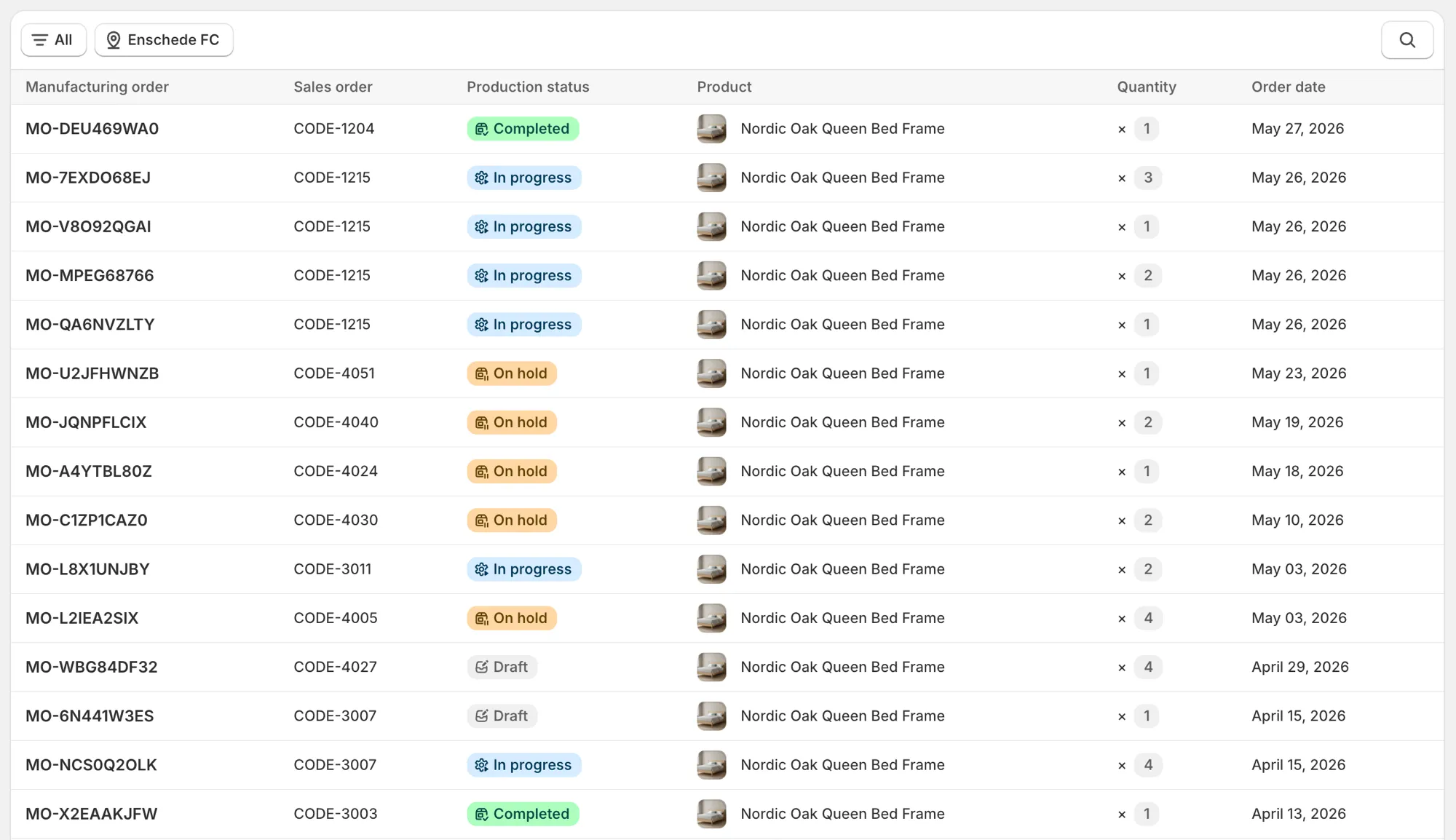
Manufacturing orders are real records in Orderkraft, not a column on a spreadsheet. Every made-to-order line item creates one. Every one carries its materials, its dependencies, its lead time, and its place in the queue.
Generated automatically
No double entry. A made-to-order sale on Shopify becomes a manufacturing order in Orderkraft. Ops doesn't transcribe anything.
Materials and dependencies
Each MO knows what it needs to be built from. Shortfalls, substitutions, and upstream blockers surface before they become a fulfillment problem.
Status and queue position
A clear pipeline of what's queued, in production, blocked, and ready. Ops opens one screen instead of three spreadsheets and a Slack channel.
Tied to fulfillment
When the MO is ready, the Shopify order is ready. Lead-time promises on the storefront come from the same data the floor is working off.
We've spent years watching production teams hold Shopify together with duct tape.
Orderkraft is built by people who've worked inside ERPs, fulfillment systems, and routing engines. And inside Shopify stores where none of that exists. We're building the production layer we kept wishing was already there.
Designed for operationally complex brands.
Production systems carry weight. We've built Orderkraft so adopting it doesn't mean ripping out what already works.
Your Shopify stays your Shopify.
Orderkraft is a Shopify embedded app. Your products, locations, fulfillment, and existing apps keep working. Nothing to replatform.
Mapped to how you actually run.
We help you translate your real bills of materials, lead times, and production locations into the system. Onboarding is a conversation, not a form.
From spreadsheets to system.
Coming from a sheet, an Airtable, or a custom Zapier setup? We help you move the logic into Orderkraft without losing the institutional knowledge baked into it.
One plan. Everything in it.
A flat monthly fee plus a fee on each manufacturing order you complete. The rate card is published, so you can work out your own bill before you install anything.
Everything
Plus $0.75 per manufacturing order, stepping down to $0.12 at volume.
One plan. Every feature. A published rate card you can do the maths on yourself.
14-day free trial. No charge during the trial, usage included.
What's included
- Bills of materials, multi-level assemblies, raw materials and components
- Manufacturing orders, production queue, holds and history
- Lead times on the product page, kept in sync with the floor
- Split shipments, so stocked items ship without waiting on production
- Shopify Flow triggers, customer-account production status
- Every production location, every user, no seat charges
There is no second plan. Nothing here is an add-on.
Billed in USD through Shopify every 30 days. Usage is charged when a manufacturing order completes.
Install Orderkraft from the Shopify App Store.
14-day free trial. Installs in minutes. Connects to your existing Shopify locations, products, and fulfillment. No replatform, no migration.
Want to see it run on your catalog first? A 45-minute walkthrough with the founder.
Not ready to install? Get one email when major updates ship. The list is for product news only. No marketing, no third parties.